
There was a song that came out about 10 years ago called, “I Took A Pill In Ibiza,” by a singer named Mike Posner. The lyrics describe his wild and lavish lifestyle as a famous singer, but turn sharply toward the despair that privately vexed him. Posner sings, “But you don't wanna be high like me, never really knowing why like me, you don't ever wanna step off that roller coaster and be all alone.” By the time he reaches the chorus, the despair reaches its peak as he laments, “Darling, all I know are sad songs, sad songs.” While the majority of us have not experienced the lifestyle that Posner describes, many people relate as he bemoans the emptiness of life.
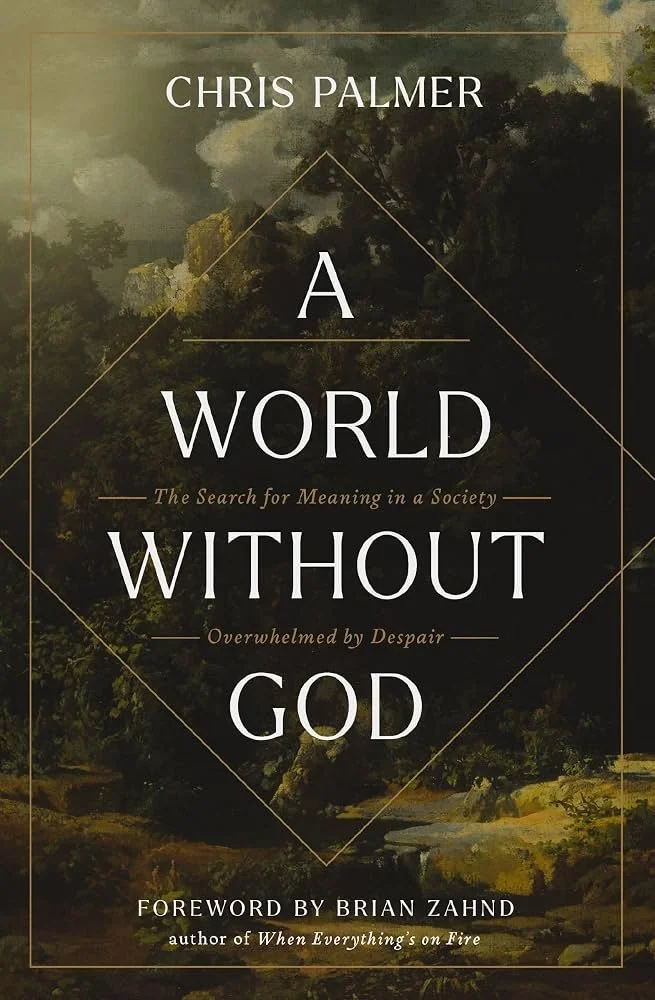
Our society has found itself stuck in the pit of despair with seemingly no way out. Life is more convenient than ever, entertainment is endlessly accessible, and the internet has connected our world in unprecedented ways. Yet, people seem to feel that their lives are more meaningless than ever. This is the issue that Chris Palmer, Dean of Southeastern University’s Theology Department, seeks to address in his new book, A World Without God: The Search for Meaning in a Society Overwhelmed by Despair.
Palmer takes the reader through a fictional town called “Novemberton”, a place where the traditional notion of “God” has become unbelievable. It is a town that has “come of age”. God sounds like a great idea, but also feels incompatible with the modern world. The townspeople still seek for higher meaning, but do so entirely apart from any traditional religious structure. They are bored, unsatisfied, and uncommitted. Their faces are sunken and tired, obviously worn out by the burden of existence. It is a place that always feels like a mundane, November day.
How did Novemberton get here? Palmer suggests that throughout history, the world has undergone four different moods. By mood, Palmer does not mean “emotional state”, but rather “the atmosphere through which the world reveals itself” (p. 25).
The first mood was the mood of the gods. In this mood, humans naturally assumed that God or many gods created, controlled, and destined things to happen.
The second mood was the mood of reason. Around the time of Plato, the divine became more abstract—an unknowable yet very real rational entity governing the universe.
The third mood was the mood of certainty. This mood was particularly defined by skepticism and an increasing reliance on the scientific method to justify knowledge. In this mood, Rene Descartes famously said “I think, therefore I am.” In other words, Descartes claimed that the only thing that was certainly real was himself because he was thinking. Humans now had to argue for the existence of God, since God existed outside the mind and could not be “proven” in a scientific or purely rational way.
The fourth mood, and the one we are currently in, is the mood of meaninglessness. In between the mood of certainty and the mood of meaninglessness, there was a great deal of optimism in human certainty and progress. Humans would solve all the world’s problems through science and reason as they abandoned “religious superstition”. One thinker, however, predicted the plight of meaninglessness that could (and would) occur after the “death” of God. Friedrich Nietzsche, a German philosopher, rejected the notion that people were objective observers of reality. Instead, he argued that humans are subjective interpreters of reality. We all put a little subjective twist on our interpretation of reality. That is why, for example, for any given cause, “One group might see it as a fight for justice. Another group sees it as disruption of order,” (p. 33). Nietzsche argued that values shape our interpretation. But if values differ from person to person, creating endless interpretations of what the true “meaning” of life is, then certainty regarding absolute meaning becomes impossible.
And that is where Novemberton is. Novemberton is nihilistic—convinced that nothing ultimate objectively exists, yet still trying to find ultimate meaning. The search is ongoing. Many attempts are given. But stability of meaning feels fleeting, if not impossible.
As Palmer walks you through Novemberton, you’ll come across many characters, each living out their own version of nihilism. Some attempt to create their own meaning, others simply accept their fate as meaningless objects in an indifferent universe. In the end, each one leaves the reader disturbed as Palmer exposes the underbelly of nihilism when fully lived out.
One character in particular stands out above the rest: The Columnist. When a plague ravages Novemberton, first killing a 5 year old boy, everyone is forced to make sense of a tragedy with no ultimate grounding for meaning. By the end of the book, The Columnist is the only character that provides a flicker of hope in a time of chaos and loss.
In A World Without God, Palmer does not have any “gotcha” moments. He doesn’t necessarily “win” an argument. Neither of those things are his intention. But, he does write honestly. He thoughtfully addresses the struggle for many to believe in a world where God feels impossible to believe in. He wonderfully engages with some of the best literary works of the last 200 years, especially Fyodor Dostoyevsky (you can tell he’s a favorite of Palmer’s). And, as mentioned earlier, he leaves the reader with a genuine sense of hope. I highly recommend reading the book as my review has only given a glimpse of its excellence. You can order a copy from Amazon here.
Nick has been attending COTR since 2000. He is an associate pastor and heads up our discipleship ministry, Impact Academy. Nick and his wife, Sera, have two kittens, Gloria and Toffee, and a baby boy, Elliot. They enjoy coffee, walks, music, art, and Mexican food.